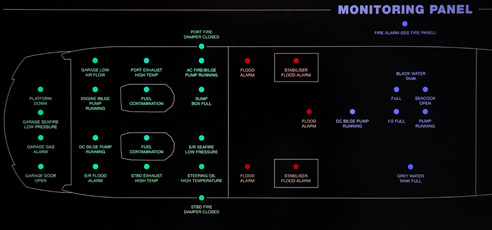
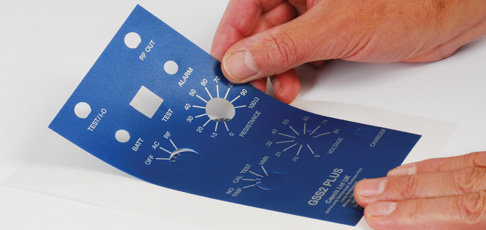
Ah, wat ik wil heet blijkbaar een "
edge lit perspex diffuser". Alle randen en oppervlakken dan zoveel mogelijk polijsten en beschermings folie aan de achterkant zelfs laten zitten! Voorzijde mat zwart schilderen; hierbij zal het relatief ruwe oppervlak van de gegraveerde delen oplichten. LED's dan dus aan de zijkanten plaatsen.
Edge lighting exploits a fun property of light called internal reflection where light can get trapped inside a transparent material. It's the same concept that makes both a diamond sparkle and optical fibers work. But we’re going to use it to make light come out of a sheet of plastic.
Simply put we shine a light in the edge* of a clear piece of plastic and etch it where we want the light to come out. With this simple, cheap method you can use a single LED to display words or images. Because it's etched into a transparent surface the images can seem to float in mid air or you can layer several of them to make a single display with more than one image or color.
Het is gebasserd op "total internal reflection". Wikipedia zegt:
Total internal reflection is the phenomenon which occurs when a propagated wave strikes a medium boundary at an angle larger than a particular critical angle with respect to the normal to the surface. If the refractive index is lower on the other side of the boundary and the incident angle is greater than the critical angle, the wave cannot pass through and is entirely reflected. The critical angle is the angle of incidence above which the total internal reflection occurs. This is particularly common as an optical phenomenon, where light waves are involved, but it occurs with many types of waves, such as electromagnetic waves in general or sound waves. When a wave reaches a boundary between different materials with different refractive indices, the wave will in general be partially refracted at the boundary surface, and partially reflected. However, if the angle of incidence is greater (i.e. the direction of propagation is closer to being parallel to the boundary) than the critical angle – the angle of incidence at which light is refracted such that it travels along the boundary – then the wave will not cross the boundary, but will instead be totally reflected back internally. This can only occur when the wave in a medium with a higher refractive index (n1) reaches a boundary with a medium of lower refractive index (n2). For example, it will occur with light reaching air from glass, but not when reaching glass from air.